Custom Solutions

Special-purpose motors and electromechanical systems built around your application.

When the catalog doesn't fit, we engineer the motor — and often the assembly around it — to your exact operating envelope. One accountable team from concept through production.

The development cycle

Concept → Analysis → Optimisation → Prototype → Controller → Production

Start a project

01Concept Design

From brief to specification.

We start with your application requirements — load profile, voltage, ambient conditions, geometry constraints, efficiency target and acoustic budget. A structured specification workshop translates these into a precise motor design brief, including topology selection (AC induction, BLDC, or PMSM), wound or squirrel-cage rotor, and insulation class.

  • Application and duty cycle analysis
  • Topology selection: AC · BLDC · PMSM
  • Thermal class and insulation strategy
  • Acoustic and vibration budget

Motor Design Brief — v1.3

Motor topology
BLDC / PMSM
Power requirement
750 W @ rated torque
Speed range
0 – 3000 rpm variable
Supply voltage
48 V DC bus
Efficiency class
High efficiency
Insulation class
Class F (155 °C)
Acoustic target
< 52 dB(A) at 1 m
Duty cycle
S1 continuous
IP rating
IP54 minimum
Mounting
B3 foot — D132 frame
10 parameters · 2 pendingSend brief →

02Electromagnetic Analysis

Multi-physics simulation at the core.

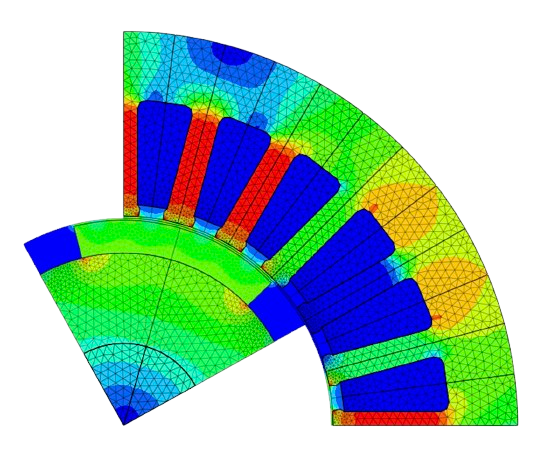
Finite element analysis across the electromagnetic domain — flux density distribution, cogging torque, back-EMF waveform, and iron loss — is carried out simultaneously with thermal and mechanical models. No sequential handoffs between domains. Every design decision is evaluated against the full physics at once.

  • FEA: flux density, cogging torque, iron loss
  • Thermal rise and insulation headroom
  • Modal analysis for acoustic targets
  • Simultaneous multi-domain evaluation

03Design Optimisation

Exploring the design space.

Automated design sweeps explore hundreds of slot-pole combinations, winding configurations, and rotor geometries. Each candidate is evaluated against efficiency, BOM cost, acoustic noise, and thermal headroom simultaneously. The Pareto front identifies designs that are genuinely optimal — not just good enough on one axis.

  • Slot-pole combination sweeps
  • Winding factor and fill optimisation
  • Multi-objective Pareto analysis
  • Cost vs performance trade-off mapping
Optimal Trade-off Sub-optimal
60 design candidates
PARETO OPTIMALBOM Cost (relative) →Efficiency (%) →82%85%88%91%94%

04Prototype Build

From simulation to steel and copper.

Physical prototypes are built and instrumented at bench level — torque-speed characterisation, thermal rise, vibration spectrum, and acoustic measurement under real operating conditions. Every significant design change is validated in hardware before committing to production tooling.

  • Torque-speed characterisation
  • Thermal rise under duty cycle
  • Vibration and acoustic measurement
  • Design refinement from test data

Motor assembly — exploded view

Front end capStator housingCopper windingsStator coreAir gapRotor assemblyDrive shaftRear end cap

Hover any layer to inspect

05Controller Integration

Motor and drive, designed together.

For BLDC and PMSM designs, the motor and its drive controller are co-designed. Field-oriented control (FOC) parameters, current loop bandwidth, speed regulation, and protection thresholds are tuned against the physical motor — not a simulation. This eliminates integration surprises before production.

  • Field-oriented control (FOC) tuning
  • Current and speed loop commissioning
  • Encoder and Hall sensor integration
  • Protection and fault-handling configuration

Motor drive system — signal topology

AC Grid3-phase 415VRectifierIGBT bridgeDC Bus680 V DCInverterPWM 16 kHzMotorBLDC 750 WEncoder1024 PPR HallFOC Controllerdq-axis loopHMI / PLCModbus RTUPower flowSignal / feedback

06Production Handoff

Engineering handoff that holds.

A complete production package — dimensional drawings, winding BOM, process parameters, first-article inspection plan, and quality control checkpoints — is delivered with the design. We support the manufacturing ramp-up and remain available through field rollout.

  • Production-ready drawings and BOMs
  • First article inspection plan
  • In-process quality checkpoints
  • Ramp-up and field support

Production readiness — milestone tracker

Design Freeze

Week 1–2

Tooling & Procurement

Week 3–5

First Article Inspection

Week 6–8

Validation & Approval

Week 9–11
  • Performance validation
  • Endurance run
  • Customer approval

Series Production

Week 12+
CompletedIn progressUpcoming

What we deliver

Four ways we work with engineering teams.

Discuss your project
01

Custom Motors

Special-purpose motors designed to a specification — torque/speed envelope, voltage, geometry, mounting, thermal class, and acoustic targets.

  • AC induction, BLDC, and PMSM topologies
  • Tailored stator/rotor geometry
  • Bespoke mounting and shaft profiles
  • Application-specific insulation and bearings
02

Electromechanical Systems

Integrated assemblies combining motor, mechanical drives, controls, and enclosures — delivered as a single accountable sub-system.

  • Motor + gearbox + drive integration
  • Sensors and feedback (encoder/tach)
  • Thermal & acoustic enclosures
  • Wiring, harnesses, and connectors
03

Prototype Development

Rapid prototype build and bench instrumentation against real operating conditions — production decisions made with measured data, not assumptions.

  • Functional prototypes
  • Bench instrumentation
  • Iterative design refinement
  • Validation report with test data
04

Production Support

Clean engineering handoff for production plus continuous support through ramp-up and field rollout.

  • Production-ready drawings & BOMs
  • Process and assembly notes
  • Quality plan inputs
  • Ramp-up and field support

In case you were wondering

Common questions about custom motor projects.

How long does a custom motor design take?
A preliminary specification and concept design direction typically takes under 72 hours from a complete application brief. Full prototype delivery is 6–14 weeks depending on complexity.
What information do you need to start?
Load profile (torque, speed, duty cycle), supply voltage, ambient conditions, physical envelope, and target cost range. The more you share, the faster and more accurate our initial response.
Do you support low-volume and prototype orders?
Yes. We work from single-unit prototypes through production programs. Prototype builds are priced separately from production runs.
What motor topologies can you design?
AC induction (single and three-phase), BLDC, and PMSM. Topology selection is driven by your torque-speed requirement, supply type, and efficiency class target.
Can you take over an existing motor design?
Yes. We can review, modify, or re-engineer an existing design — improving efficiency, noise, cost, or reliability — and take it through validation and production handoff.
Let's build your next motor system

Share your application — our engineering team will propose the right solution.

We respond to enquiries within one business day with a clear next step: a quick technical call, a spec questionnaire, or a quote.